To celebrate Nietzsche birthday let’s compute something relevant a bit to to the philosophy he founded, existentialism, and it’s Eastern counterpart (as some people think) – zen. Wolfram Function Repository provides a unique opportunity for the Wolfram Language users to publish their own algorithms and immediately use them from within the Wolfram Language. I have […]
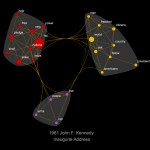
Idea-nets and uniqueness of US inaugural addresses
What is common between a symphony and a novel? They both progress linearly in time. This is why songs match lyrics and music so well. This seems obvious but comprehension of spacial objects is different. You can look at a two-dimensional painting and your sense of art is driven by the simultaneous perception of different […]

Who Owns the West? Federal Lands 2014
This map is a spectacular example of how data reshape public perception and knowledge. Very simple in nature it nevertheless shocks an average citizen by giving clarity to the data usually buried in obscure tables. East versus west, federal versus private, – the contrast is sharp and reverberates in the minds entangled with American history. […]
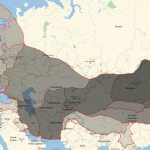
Computational history: countries that are gone
X – country birth | Y – country death | RADIUS – lifetime Mongol Empire The Mongol Empire existed during the 13th and 14th centuries and was the largest contiguous land empire in history. Originating in the steppes of Central Asia, the Mongol Empire eventually stretched from Eastern Europe to the Sea of Japan, extending […]
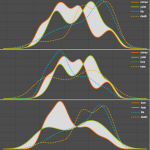
Evolution of topics in Romeo & Juliet
The actual APP that does some analysis of Shakespeare’s “Romeo and Juliet” is located HERE. Please wait through a potential little load or evaluation times, it is computing! Read below for the explanation of how app works and other ideas on Shakespeare’s data mining. April 23, 2016 marks 400th anniversary of Shakespeare’s death. Just a […]

Interactive 3D Barth Sextic Surface
“The Barth-sextic is a sextic surface in complex three-dimensional projective space having the maximum possible number of ordinary double points, namely 65. The surface was discovered by Wolf Barth in 1994, and is given by the implicit equation: where phi is the golden ratio.” ~ MathWorld. We can write short Wolfram Language code ( by […]
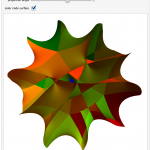
Interactive 3D Calabi-Yau Surface
Wolfram Language allows creation of computational 3D models. These are different from those you can build with your own hands such as SketchUp etc, because computations are often intrinsically different from the way humans see and think. Let’s take for example Calabi-Yau Surface. It is a mathematical object and it is hard to imagine it. […]
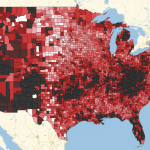
Drug overdose trends in USA counties 1999 – 2014
The data Drug Poisoning Mortality: United States, 1999–2014 are published by USA government. In a few recent blogs (1, 2, 3) static visualizations of data were performed. Here we show how to animate maps of geographical drug overdose spread in USA. Below you can see 4 images, each reflecting upon Age-adjusted death rates for drug […]
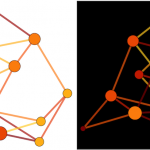
On design of styles for small weighted graphs
I sometimes get asked what is the best way to style edges and vertices with different numerical values, like weights or centrality measures, for example. In this post i will go over small graphs, because large graphs are a very different story and require a different, sometimes opposite approach. A network is a messy creature, […]
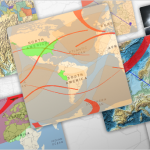
Solar Eclipses from Past to Future, Earth to Jupiter
Read my new article published by the Wolfram Blog: Solar Eclipses from Past to Future, Earth to Jupiter.
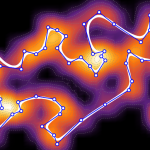
Find Waldo Faster
Read my new article published by Wolfram Blog: Find Waldo Faster. Here are some images from the article.
Modeling a Pandemic like Ebola
Please read my new blog post published by Wolfram Research: Modeling a Pandemic like Ebola with the Wolfram Language Click here for a Russian translation.
Happy ASCII New Year ;-)
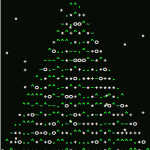
I can occasionally appreciate a nice ASCII art design. But the better is the design, the more manual and custom approach it needs – or so it seems. It is actually quite challenging, if you think about it, to transform a known image or shape to a limited medium using finite set of geometries. So […]

t * sin (t) = Christmas tree
Another code sample from Wolfram Community. I noticed that a discussion about programming a lighted Christmas Tree from a simple equation t*Snt[t] became very popular on Reddit. It is connected to a project a programmer developed. I thought how fast we can make it with Wolfram language? Here is the result with slight flickering 😉 […]

Dancing with friends and enemies: swarm intelligence
This post is based on a thread from Wolfram Community. The rules by Simon Woods are simple: 1000 dancers assume random positions on the dance-floor. Each randomly chooses one “friend” and one “enemy”. At each step every dancer moves 0.5% closer to the centre of the floor, then takes a large step towards their friend […]

Mighty reads: “Jonathan Strange & Mr Norrell” by Susanna Clarke
Harry Potter for adults. Long thoroughly enjoyable volume. Magic told as if would be part of society. Cold British political satire soaking every page, every sentence. I would call this “action in slow motion”. Because there is action. And suspense. But a gentlemen shall move with a respectful grace. And so we shall read. “Neil […]
Iconography for Elementary Cellular Automata Based on Radial Convergence Diagrams
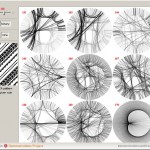
My recent publication at the Wolfram Demonstrations Project: “Iconography for Elementary Cellular Automata Based on Radial Convergence Diagrams“. Consider a complete set of initial conditions for a finite elementary cellular automaton (ECA). This set can be indexed by integers using a Gray code or a binary to decimal conversion. During the ECA evolution, the […]
Mighty reads: “The Dog Stars” by Peter Heller
This is a great little book. I recommend the audio book edition read by Mark Deakins. A few good qoutes. “[The Dog Stars] gripped me—it’s the real deal. Heller’s voice is extraordinary and his narrator’s toughness seems to hide a beautiful and aching restlessness. One of those books that makes you happy for literature.” —Junot […]
Order, Chaos, and the Formation of a Cantor Set Attractor in Elementary Cellular Automata
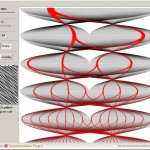
My recent publication at the Wolfram Demonstrations Project: Order, Chaos, and the Formation of a Cantor Set Attractor in Elementary Cellular Automata Consider finite elementary cellular automata (ECA) of size 10. All possible binary vectors of length 10 form a complete set of initial conditions (CSIC). Every step of an ECA evolution maps this set to […]
Estimated remaining time: monitoring lengthy computations
I just posted on Wolfram Community. For comments – go to the original post. An here is what it is about. I sometimes run lengthy computations, overnight or even a few days. We have built in Monitor function to track the progress of a variable. But I often find it useful to estimate how much […]
Diagrammatic


Vitaliy's bookshelf: read


Rare exceptional book. Harry Potter for adults. Long thoroughly enjoyable volume. Magic told as if would be part of society. Cold British political satire soaking every page, every sentence. I would call this “action in slow motion”. Bec...

This is a great little book. I *highly* recommend the audio book edition read by Mark Deakins. A few good qoutes.
“[The Dog Stars] gripped me—it’s the real deal. Heller’s voice is extraordinary and his narrator’s toughness seems to hide...

I would highly recommend this book to anyone who is a fan of fiction. Exceptional style of writing wraps twists of story-line unraveling the mystery in rich poetic and metaphoric language. Besides dramatic roller-coaster of events and em...


It is definitely a well written book and it is worth reading if you are interested in fresh unusual plot. While twists and turns are NOT predictable and surprise one pleasantly, keep one guessing, the moral philosophy IS quite predictabl...
